AIOps Enablement(AIOE): Mindset, Studio, and the Observability & Troubleshooting Stack 
The AIOps Enablement: From Tools to Enablement, Not Just Operation, Development, Engineering, but a Culture of Enabling AI to Business Impact 
Our approach to AIOps is a fundamental shift in how we operate, guided by these core principles:
- Telemetry as a Product: We treat telemetry data—metrics, logs, traces, and events—as valuable product assets that drive decision-making across the entire service lifecycle.
- User-Centric and SLO-Driven: We start with the customer experience. By defining Service Level Objectives (SLOs) based on user impact, we work backward to identify the critical signals needed to maintain service quality.
- Automation-First, Human-Augmented: We automate repeatable tasks and standard responses to reduce manual toil. This allows our engineers to focus on high-impact problems, armed with curated, context-rich information.
- Closed-Loop Operations: We follow a complete cycle for every event: Detect → Enrich → Correlate → Decide → Act → Learn. This ensures that every action taken improves the system, whether through updated rules, machine learning models, or refined AI prompts.
- Continuous Learning: We foster a culture of continuous improvement. Every incident, automated workflow, and suppressed alert feeds back into our pattern libraries, making our operational intelligence smarter over time.
Architecture 
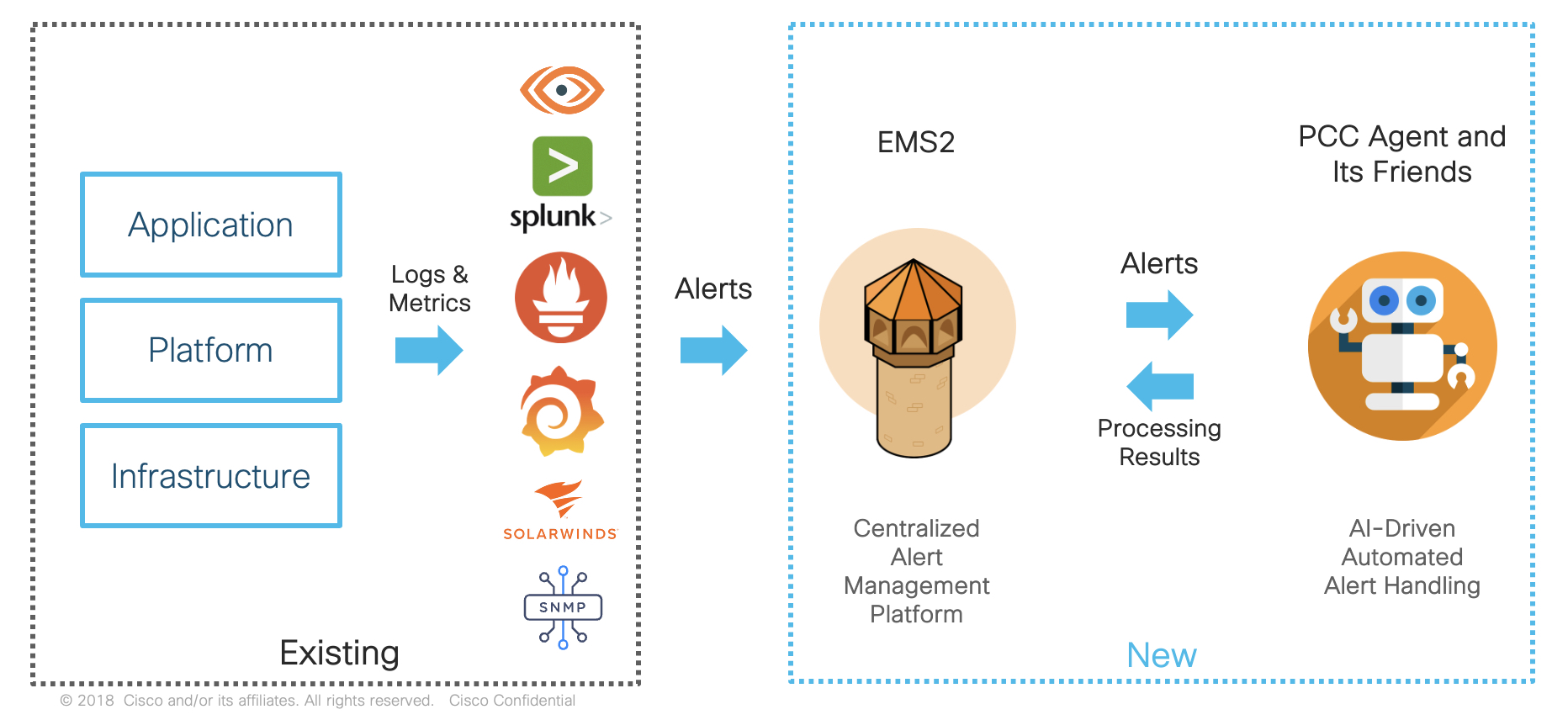
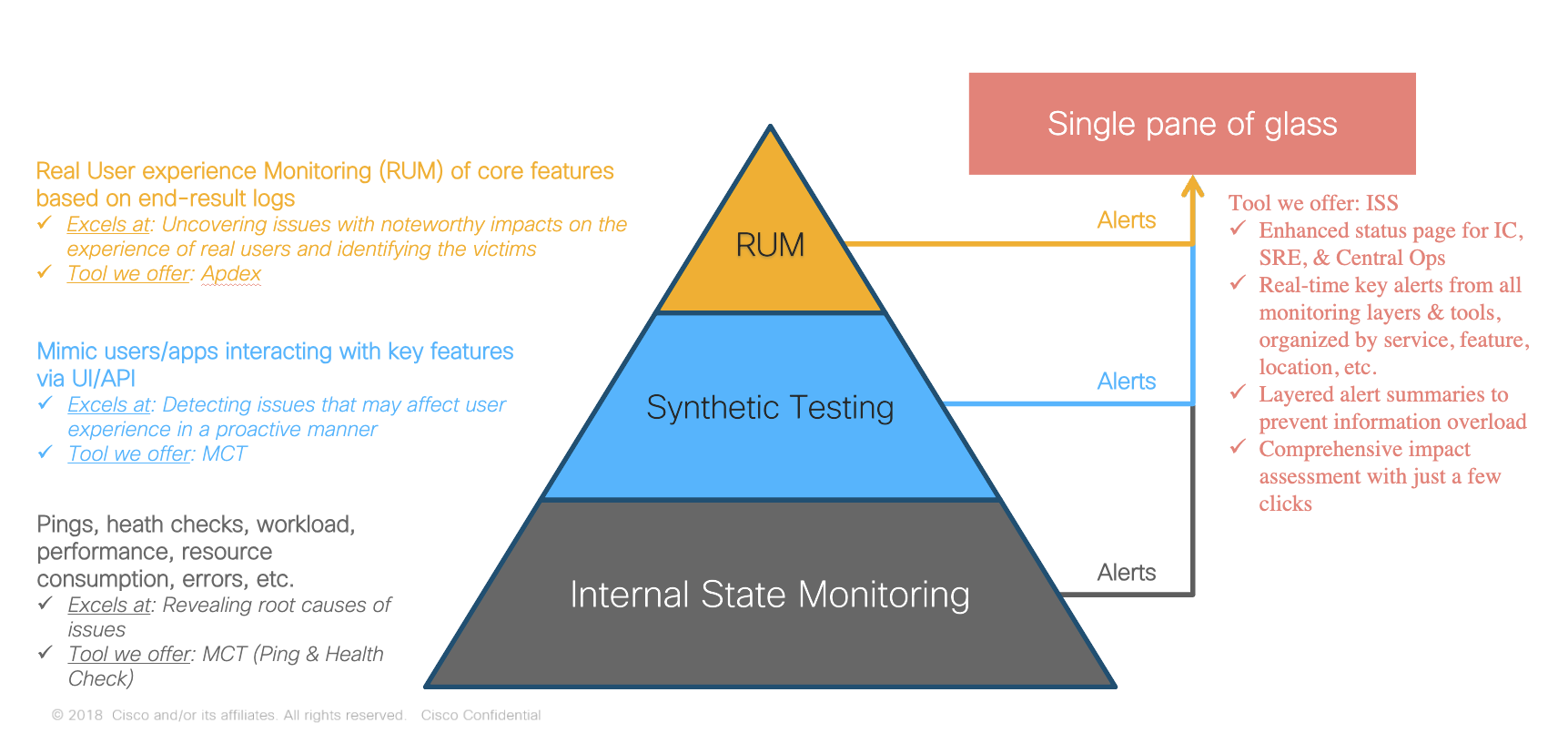
Tools Stack 
- Real User Experience (Apdex)
Live user telemetry, feature experience scoring, SLO / error budget signals drive impact-first decisions (incident, release hold, experiment guardrails).
- Synthetic & Readiness (MCT)
Global functional, E2E, environment & site readiness probes reused across pre-prod validation, post-change verification, expansion (DC / region turn-up), and resilience scenario testing.
- Alert & Event Intelligence Hub (EMS2)
Consolidates, deduplicates, and correlates alerts to reduce noise. Enriches signals with operational context (ownership, topology) and forwards actionable incidents to EAP agents for response and remediation.
- Governed Agent Execution Plane (Enterprise Agent Platform (EAP))
Runs reviewed AI agents under a governed runtime (sandbox, guardrails, audit) for automating operational tasks like incident triage, release gating, and change risk assessment. Agents reach external systems only through approved MCP servers; deployment and access are controlled via Git-tracked review on the project repo plusenterprise-agent-platform-registry.
- Internal Service Status (ISS)
Provides an all-in-one view of core service feature health for internal stakeholders like engineers, leadership, and service owners. It automatically collects and correlates signals from diverse monitoring sources with production incidents to present a unified status.
- Global Service Status (GSS)
Offers a public-facing, all-in-one status page for Webex end-users. It publishes all relevant service information, providing a transparent view of core feature availability and overall platform health.
Historical vidcasts (EMS2 + n8n era — n8n has been retired in favor of EAP):
Welcome
Welcome to Monitoring as a Service (MaaS) Wiki.
- Real User Monitoring (RUM): Apdex
- Synthetic Monitoring: Monitoring Console Tool (MCT)
- Event-based Monitoring: Event Management System (EMS)
- Event Manager: EMS v2
- Internal engineer facing Status: Internal Service Status (ISS)
- External customer facing Status: Webex Global Service Status platform (GSS)
Numerous documents are associated with the Cisco IT wiki and Cisco Confluence. In the event of encountering difficulties with displaying images or experiencing non-functional links, kindly ensure that you have authorized access to both of these platforms.