Introduction
What is Event Management System (EMS2) 
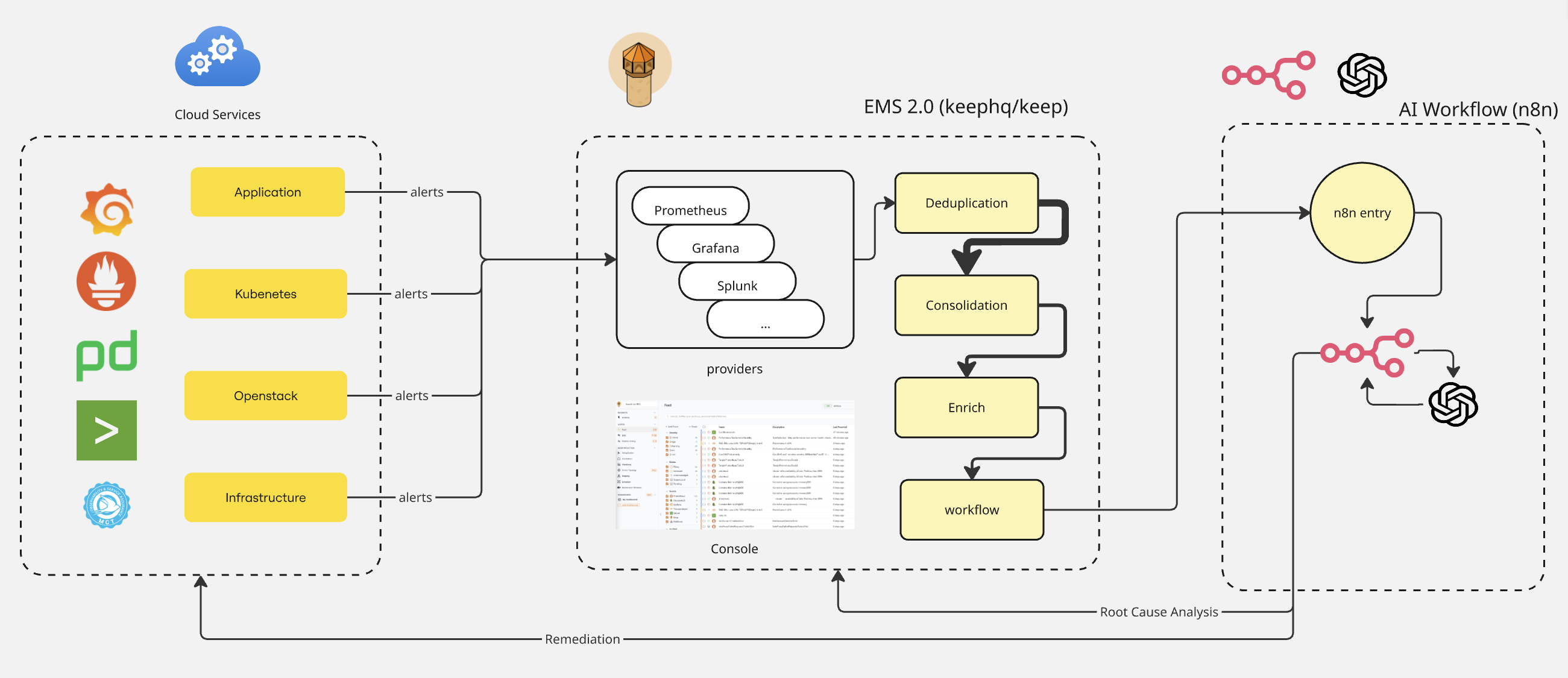
Event Management System, also known as EMS2, is the next-generation Event Management System and a new version of the organization's central Event Management System. It is a complete re-architecture and replacement of the existing legacy system, leveraging the powerful open-source AIOps and alert management platform, keephq/keep.
EMS2.0 is designed to serve as a unified, intelligent, and highly extensible platform for aggregating, managing, and automating responses to alerts from across the entire IT infrastructure. By moving away from a monolithic, legacy codebase, EMS2.0 embraces a modern, containerized, open-source approach, enabling seamless integration with a wide array of third-party monitoring tools, ticketing, and communication tools including but not limited with Prometheus, Grafana, Kibana, Splunk, CloudWatch etc. Its core purpose is to transform a high volume of raw alerts into actionable insights and automate incident remediation, significantly reducing alert fatigue and improving operational efficiency.
Furthermore, EMS2.0 will integrate with n8n automated workflows and incorporate Large Language Model (LLM) agents to perform advanced AI-powered actions such as intelligent root cause analysis and automated remediation, significantly reducing alert fatigue and improving operational efficiency.
Advantage 
The migration to EMS2.0, powered by keephq/keep, offers a multitude of advantages over the existing legacy Django-based system:
1. Centralized Alert Aggregation & Single Pane of Glass:
EMS2.0 acts as a central hub, consolidating alerts from diverse monitoring tools and systems into a single, intuitive interface. This eliminates the need to jump between multiple dashboards, providing a comprehensive overview of the entire system's health.
2. Enhanced Noise Reduction and Alert Correlation:
Leveraging keephq/keep's intelligent AIOps capabilities, EMS2.0 provides advanced features for alert deduplication, filtering, and correlation. This significantly reduces the volume of alerts, allowing teams to focus on truly critical incidents and minimize alert fatigue.
3. Powerful Automation and Workflow Orchestration:
At its core, EMS2.0 utilizes keephq/keep's YAML-based workflow engine, similar to GitHub Actions. This enables the creation of highly customizable and automated processes that trigger in response to specific alerts. This includes:
- Automated Enrichment: Automatically adding context to alerts from external sources (e.g., CMDBs, databases).
- Automated Response: Triggering actions like updating Jira tickets, sending notifications to communication platforms (Slack, Teams), or executing custom scripts (Python, Bash) for initial remediation.
- Escalation Policies: Defining automated escalation paths based on alert severity and team on-call rotations.
4. Extensive Third-Party Component Integration:
EMS2.0's foundation on keephq/keep provides out-of-the-box bi-directional integrations with a vast ecosystem of tools, including:
- Observability Tools: Datadog, Prometheus, Grafana, Splunk, etc.
- Incident Management: PagerDuty, OpsGenie, Grafana OnCall, etc.
- Ticketing Systems: Jira, ServiceNow, GitHub Issues, etc.
- Communication Platforms: Slack, Microsoft Teams, Google Chat, etc.
- Databases and Data Warehouses: MySQL, PostgreSQL, Snowflake, etc.
This extensibility allows for a highly customized and integrated monitoring and incident response ecosystem.