Webex Basic Knowledge
Basic 
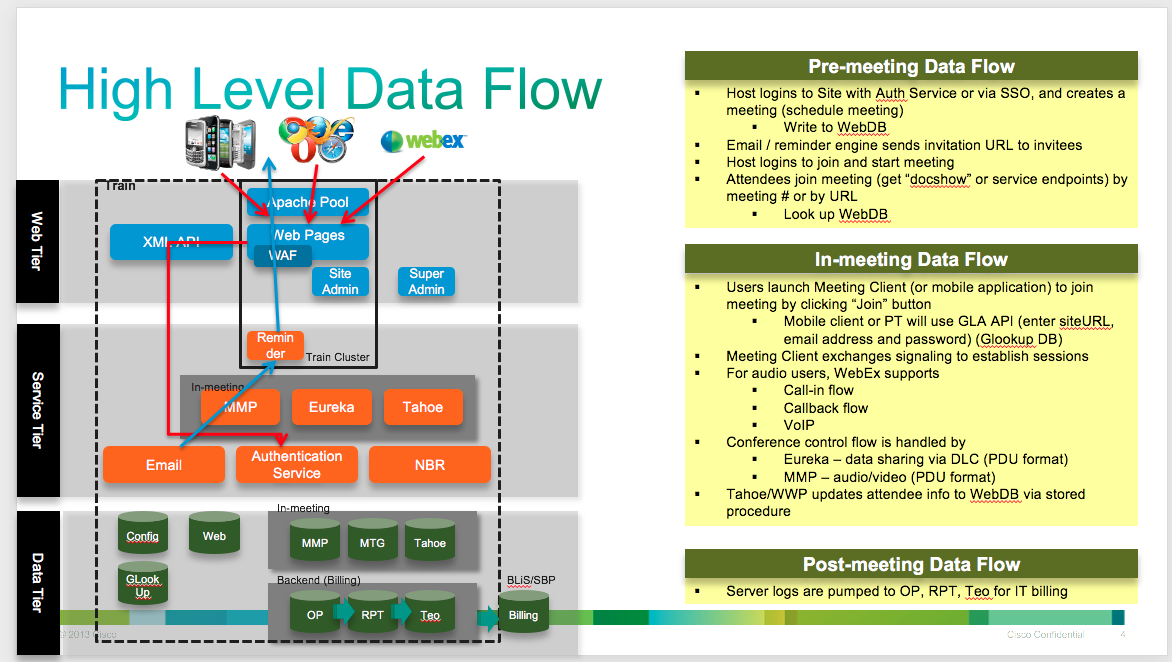
- Meeting flow
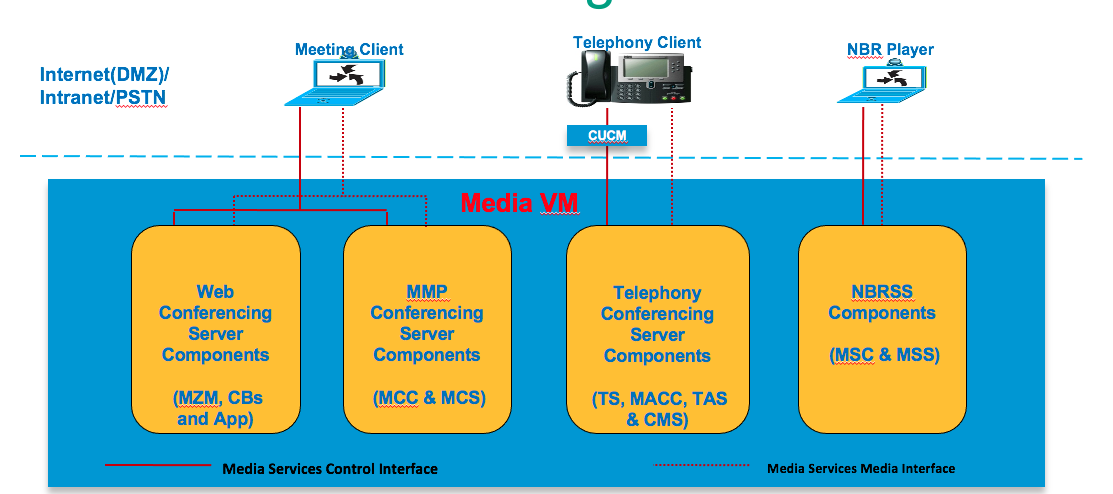
- Client connection Quick view
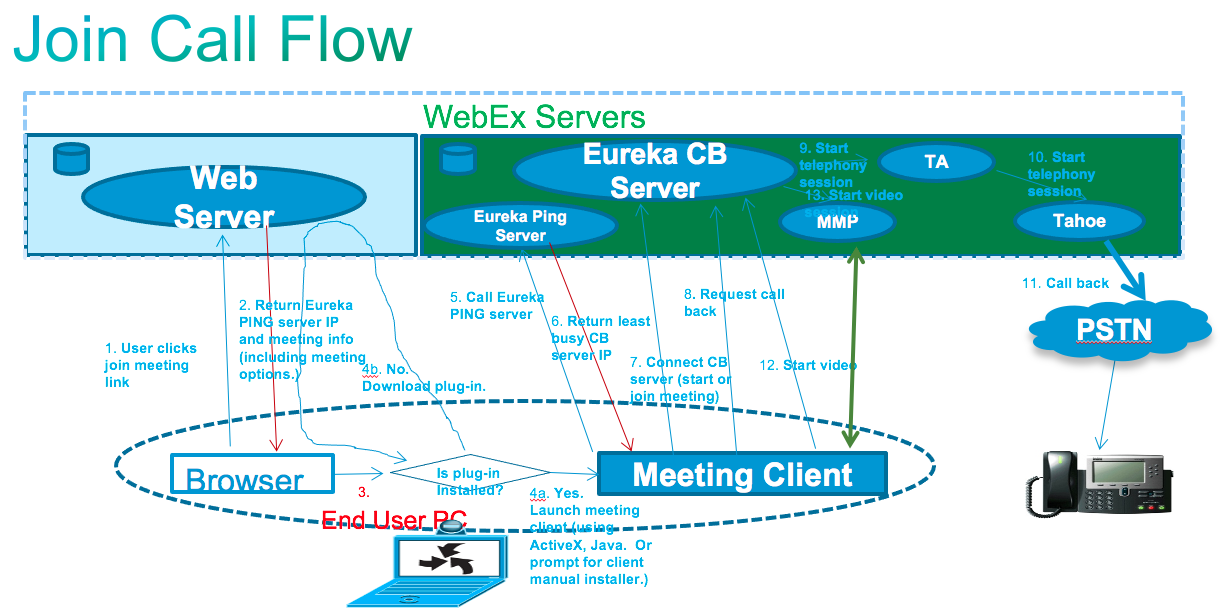
- Join Call Flow
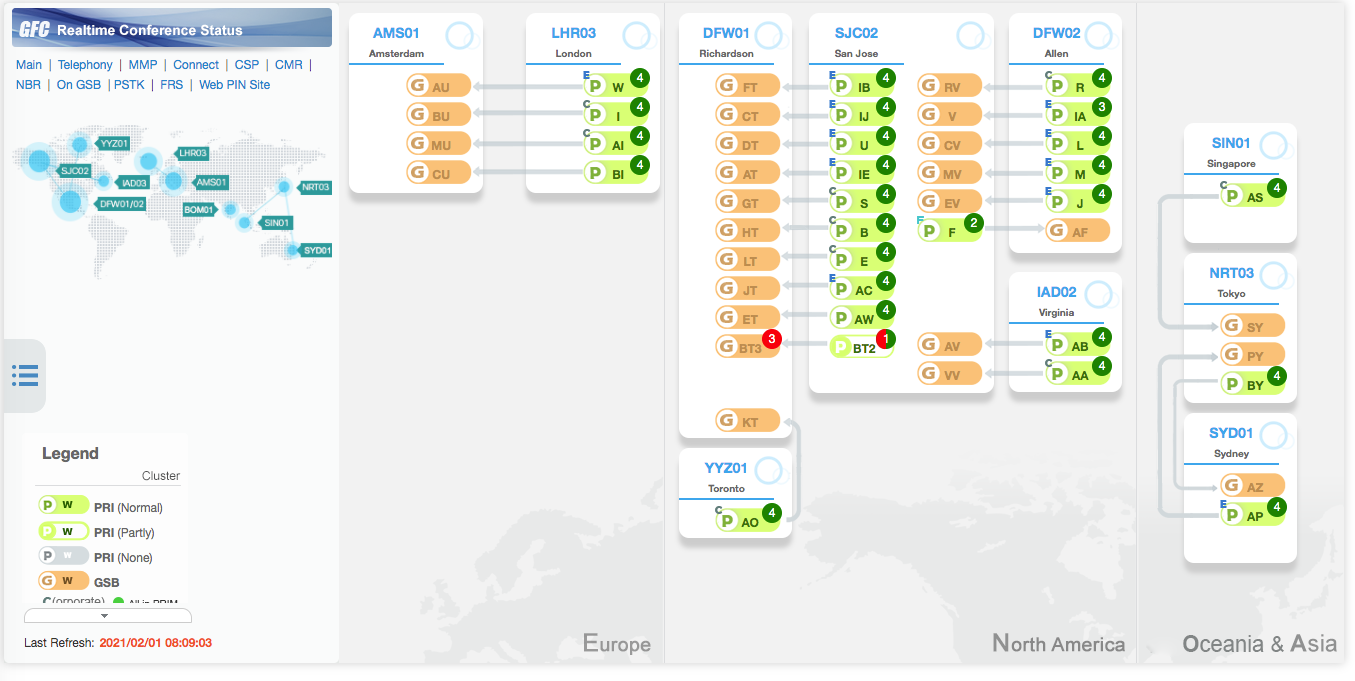
- Meeting conference map
Web Domain 
- Web and backend API microservice design
- Web and Backend BFF API Design
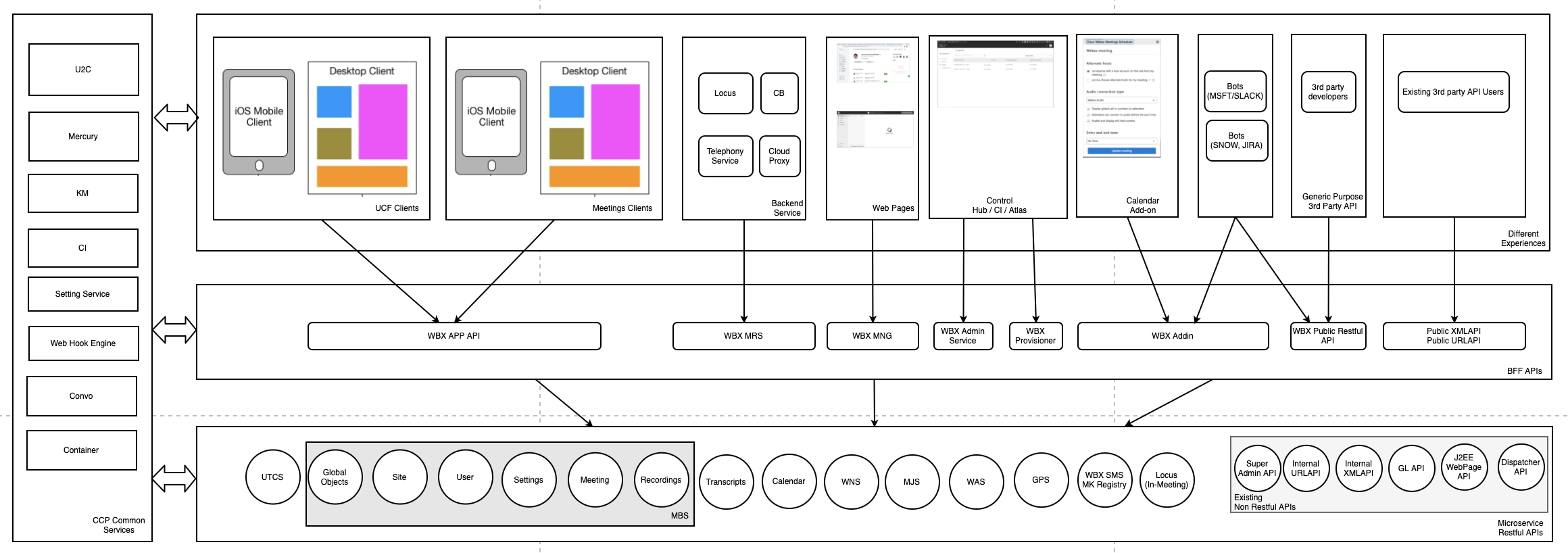
Web Application 
- CMR (Collaboration Meeting Room, integrate Webex Meeting with TelePresence) - CMR Cloud: Cloud version of CMR - CMR Hybrid: On Premise version of CMR
- PMR (Personal Meeting Room, virtual conference room of person)
- Recording (NBR)
- Site Admin (WBXAdmin. covering Standalone site, CI unified site and CI linked site)
- Support Center
- Training Center
- Webex NG Web App
Web Service 
MRS 
MRS (Meeting Registry Service) Key responsibility:
- Single source of truth for scheduled and lookup meetings - For global unique meeting numbers for PSTN and Video Dial in - A Global Unique UUID for different tools to inter-ops - Façade of scheduling meetings used by PT, TMS, Calendar Service and Web Scheduler - Unified API entry to look up WebEx meeting
- Easy to adopt(No Migration) - Avoid migration of existing WebEx Data to provide a common solution
- Syndicate with multiple calendar service provider - Can work with Calendar Service, which customer work on Exchange and Google Calendar Scheduling - Can work with cases Customer use WebEx Web Scheduler
- Architecture overview

MBS 
MBS (Meeting Business Service) is a bunch of API open for Web Applications to manage backend web services
MJS 
- Webex Join Flow - Classic Join

WAS 
- WAS (Web Authentication Service) manage the process of authentication involving oAuth and Token refresh etc.
+----------+
| Resource |
|   Owner  |
|          |
+----------+
    ^
    |
    (B)
+----|-----+          Client Identifier      +---------------+
|         -+----(A)-- & Redirection URI ---->|               |
|  User-   |                                 | Authorization |
|  Agent  -+----(B)-- User authenticates --->|     Server    |
|          |                                 |               |
|         -+----(C)-- Authorization Code ---<|               |
+-|----|---+                                 +---------------+
|    |                                         ^      v
(A)  (C)                                        |      |
|    |                                         |      |
^    v                                         |      |
+---------+                                      |      |
|         |>---(D)-- Authorization Code ---------'      |
|  Client |          & Redirection URI                  |
|         |                                             |
|         |<---(E)----- Access Token -------------------'
+---------+       (w/ Optional Refresh Token)
Sign Service 
Sign Service: Use NFS as a new user first time joining meeting method, SignService is responsible for signing and writing the following data to Webex.exe to ensure that the new user can be successfully join meetings through NFS.
- Sign Service Work Flow

WbxAppAPI 
- Wbx App API - Wbx App API is designed for Webex meeting clients to call our APIs, and adopt BFF pattern to build client friendly APIs. - High Level Architecture

Internal Reference 
Meeting Domain 
Eureka 
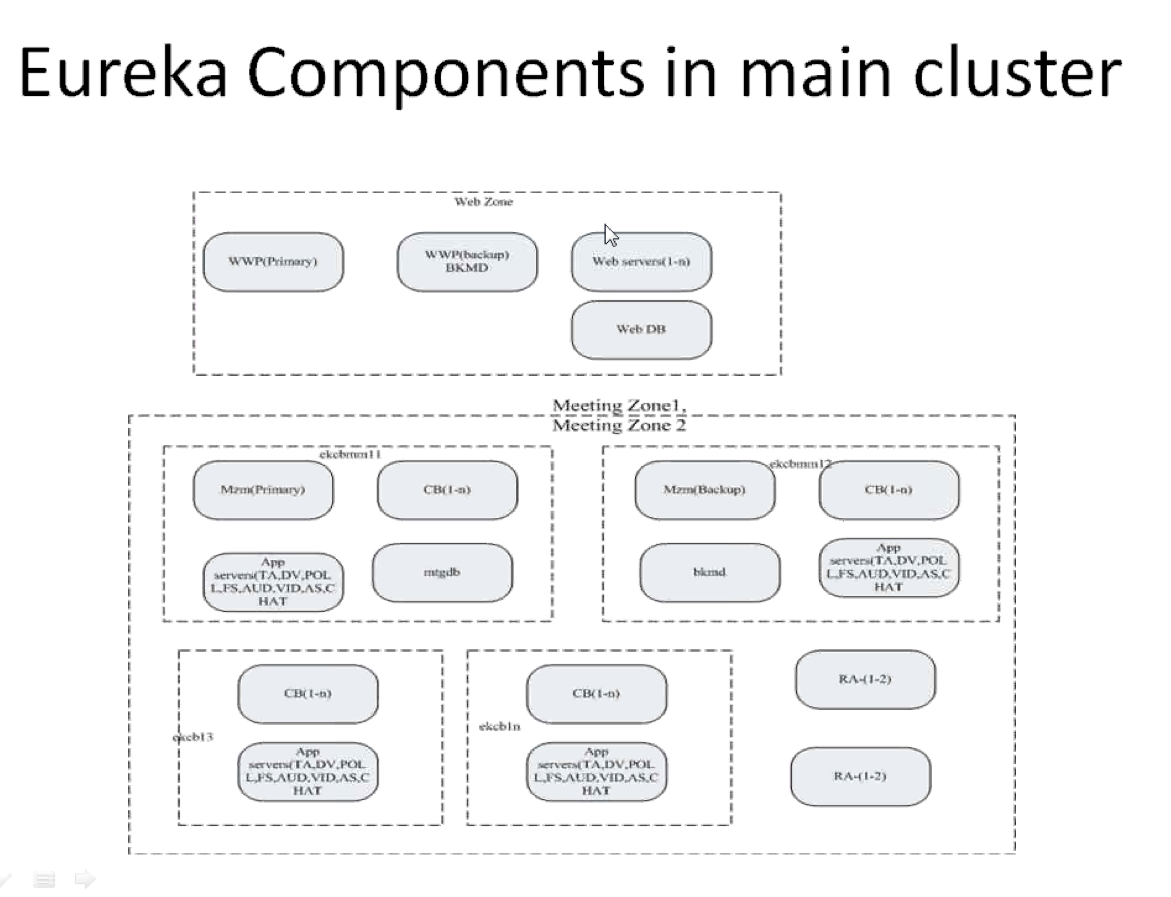
Eureka is a group of servers(CB/MZM/RA/TA/WWP) which collaborated each other to provide global customers with real-time data meeting service via internet. A Cluster consists of a Web Domain and a Meeting Domain, and a Meeting Domain has two meeting zone. A GDM can be shared by multiple clusters, but the WebEx Node Domain installed within the enterprise cannot be shared.
- Eureka Service Map
- Eureka Introduction Recording in Mandarin
- Eureka Component
Work Flow 
- Create Meeting 1. User access web to start meeting 2. Meeting client is loaded and get meeting&system parameter from web(web get from web DB) 3. Meeting client ping MZMs 4. MZMs return available CB in its zone to meeting client 5. Meeting client select a best CB according load balance policy and send start/join meeting request to the CB. 6. CB send meeting start notification to MZM 7. MZM notify WWP to update web DB, and sync to other MZMs in the same domain 8. WWP update meeting status to web DB. the meeting state in page will be changed to “join”.

- Join Meeting
1. User access web to join meeting 2. Meeting client is loaded and get meeting&system parameter from web(web get from web DB) 3. Meeting client ping MZMs 4. MZMs return available CB in its zone to meeting client 5. Meeting client select a best CB according load balance policy and send start/join meeting request to the CB. 6. CB send meeting join notification to MZM if the CB is new join to the meeting

Eureka Components 
- MZM (Meeting Zone Manager): Meeting zone Management and provide service of balancing load of CBs.
- CB (Collaboration Broker): Provide capability of hosting meeting and switching data.
- RA: Provide connecting services for Remote Access agents
- TA (Teleconference Agent) - Functionality: Functioning as a proxy/agent from data meeting with Telephony meeting.
- WWP (WMS Web Proxy) - Functioning as a bridge between Web Domain and Meeting Domain - Functioning as database proxy to update meeting status into Web DB (CB -> MZM -> WWP -> Web DB)
- WebDB: Persist meeting status
- TPGW: connect Cisco TelePresence and Integrated Agent
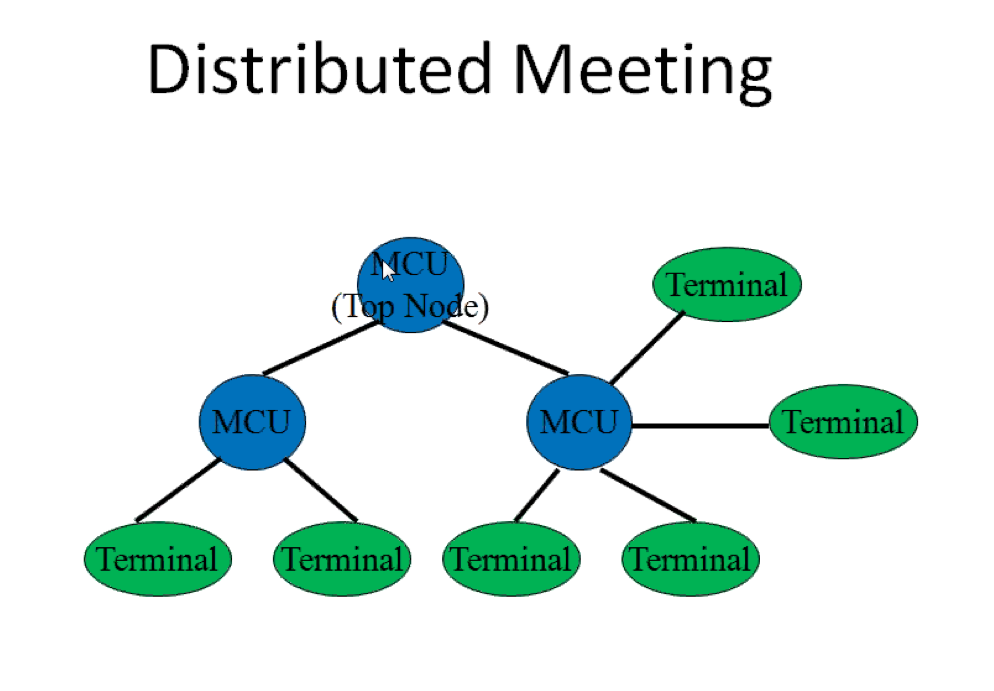
Distributed Meeting 
- Distributed Meeting
GDM 
- Eureka Global Deployment Diagram

TPGW 
TPGW (Webex TelePresence GateWay) acts as a WebEx meeting client proxy for tele-presence device to create/join WebEx meeting, acts as a limited capability WebEx meeting client. TPGW works for following scenarios of TP Endpoint joins to Webex meeting
- TP endpoint in on-premise(CMR-Hybrid)
- Cloud endpoint on legacy TP server. (CMR-Cloud V3)
- Cloud endpoint on CCP. (CMR-Cloud V4)
MMP 
MMP(Multi-Media Platform) service contain MCS(Media Conference System) and MCC(Media Conference Controller), and provide security and High availability function such as:
- Audio Broadcast
- Legacy VoIP
- WebEx HD Video
- Streaming Video Sharing (SVS)
- Hybrid or mixed mode with PSTN/VoIP users in same session
- NBR recording/streaming playback.

MMP Overview 
- MMP Module Diagram

- Overview of MMP in AWS

MMP Components 
- MCC (Media Conference Control): manager of the MCS servers; conference management, load balance for MCS servers, data sync with MCC servers, interaction with TS and CB server, DB log (Billing);
- MCS (Media Conference Server): the server support Webex video/audio/svs/ab sessions.
CME 
CME(Common Media Edge) is an aggregate media edge architecture for real-time media communications based on SIP. Besides SIP, CME provides limited interoperability for H.323 and Skype for Business specific SIP communications. Media Edge is a concept and logical grouping of components that perform a similar function. The function here is of a session border element. Just as for IP network there is a demarcation between enterprise edge and service provider edge, for real-time media communications we need a similar demarcation.
The media edge as a collective provides this function of a border element for SIP and H.323 signaling as well as RTP media stream. All communications in/out of the cloud is anchored at the media edge. Doing so provides us with the following capabilities
- Topology Hiding
- Load-Balancing
- Call Admission Control
- Seamless scalability and redundancy
- Interoperability
- Manipulation capabilities
- CME Overview
- CME Detailed Diagram

CME Components 
CUSP 
CUSP (Cisco Unified SIP Proxy): main signaling component in CWCRE (CiscoWebex Call Routing Engine)
- CUSP Types: - eCUSP - to interface with SPs that are external to Cisco. - eCUSP-PSTN - eCUSP-CCA - eCUSP-CCE - eCUSP-Phone - eCUSP-Lync - ... - iCUSP - to interface with services internal to Cisco. - iCUSP-PSTN - iCUSP-SparkPSTN - iCUSP-WebExPSTN - iCUSP-CMR
- CUSP Hardware

CUBE 
CUBE (Cisco Unified Boarder Element) role in CCAX is similar to what is used for other Webex audio services like CCA-SP / CCA-Ent and WebEx PSTN. Call flow handling for dial-in and callback will be inline with these existing service.
- Role of CUBE
 - RTP (the Real-time Transport Protocol) is a network protocol for delivering audio and video over IP networks. RTP is used in communication and entertainment systems that involve streaming media, such as telephony, video teleconference applications including WebRTC, television services and web-based push-to-talk features. - SRTP (The Secure Real-time Transport Protocol) is a profile for Real-time Transport Protocol (RTP) intended to provide encryption, message authentication and integrity, and replay attack protection to the RTP data in both unicast and multicast applications. It was developed by a small team of Internet Protocol and cryptographic experts from Cisco and Ericsson. It was first published by the IETF in March 2004 as RFC 3711.
VCS 
Cisco TelePresence Video Communication Server
- SIP Proxy/Register
- Call Control
- H.323 Gatekeeper
- Firewall Traversal Server
- Device provisioning
- SIP/H.323 Interworking
- VCS Deployment

Cloud Proxy 
Cloud Proxy CloudProxy (CP) is a SIP Proxy and is deployed as SIP signaling edge for all the WebEx cloud solutions - CMR 4.0, CMR 3.0, WebEx Edge Audio, WebEx Audio.
CME Related 
CCA 
CCA (Cloud Connected Audio) is a cost-effective prots-based audio conferencing solution to send audio directly over SIP trunks established between Cisco and Enterprises or Service Provides.
- CCA Portal - CCA Portal is a repository for all CCA content, including customer contact information, network configuration, reporting, and Telephony configuration (telephony domain + callback group.)
CMR 
CMR (Collaboration Meeting Room) Training recording from Sunil V is HERE
CMR 3.5 
- CMR 3.5 Training Material
- Overview of various components in Spark - Locus - Responsible for setting up the call (Stateless) - Hecate - System that facilitates communication with Webex Meetings components (Stateless) - Orpheus - This is the orchestrator that menages the resources (also loadbalancing) used in Linus and Mygdon. Resource allocate happens here once a call comes in (Stateless) - Rhesos - This component IVR extension of Locus, it's responsible to playback prompt, collect DTMF, etc. - Linus - This is the device where media terminates from the external world (public address). It copies the media and sends it to the Mygdon using private IP address (Stateful) - Mygdon - Handles IVR for media. It just collects the DTMF digits and passed them to Rhresos for verification - Edonus - This is the component that does the media mixing (both audio and video in different resolution. It has 32/48 CPU cores(Statefull)) - L2SIP - Translates from SIP to REST format fo rLocus and vice versa


CMR 4 
- CMR 4 Call Flow

Difference between CMR3 and CMR4 
Wiki is HERE. CMR3 could refer to Tahoe Figure below.
Telephony Service 
Tahoe 
Tahoe is code name for below components and functionalities:
- WebEx Telephony Application Server
- WebEx PSTN/CCA audio conference/call control
- WebEx CMR SIP signaling control
Tahoe Sharing Series is HERE
- Tahoe Architecture Diagram

- Tahoe in Webex

- Typical SIP Call Flow including - Webex PSTN Dial-in/Dial-out - Spark PSTN Dial-in/Dial-out - CMR Video Dial-out - CMR Cascade Link
- Tahoe Knowledge Share
Tahoe and CMR 
Tahoe with CMR 3 

Tahoe with CMR 3.5/4 

GIVR 
All telephony bridges will behind of GIVR(Global Interactive Voice Response) and share one set of service numbers. GIVR mainly take IVR stage and transfer the user to join Telephony audio conference according to WebEx meeting key. GIVR only focus on dial in. Right now, dial out is out of GIVR scope.
- GIVR Service Map
- GIVR adoption in Webex
- GIVR Service Architecture Overview
- GIVR for Webex

- GVIR for Spark


CMS 
CMS(Collaboration Media Server)
- TAS(Telephony Application Server)
- CMS overall architecture
